
HORIZON
Observatory for Complex Systems
Understanding Transformation in Complex Systems
An independent scientific initiative dedicated to the study of emergence, organization and transformation in complex adaptive systems.
Investigating how complex systems change before change becomes visible.
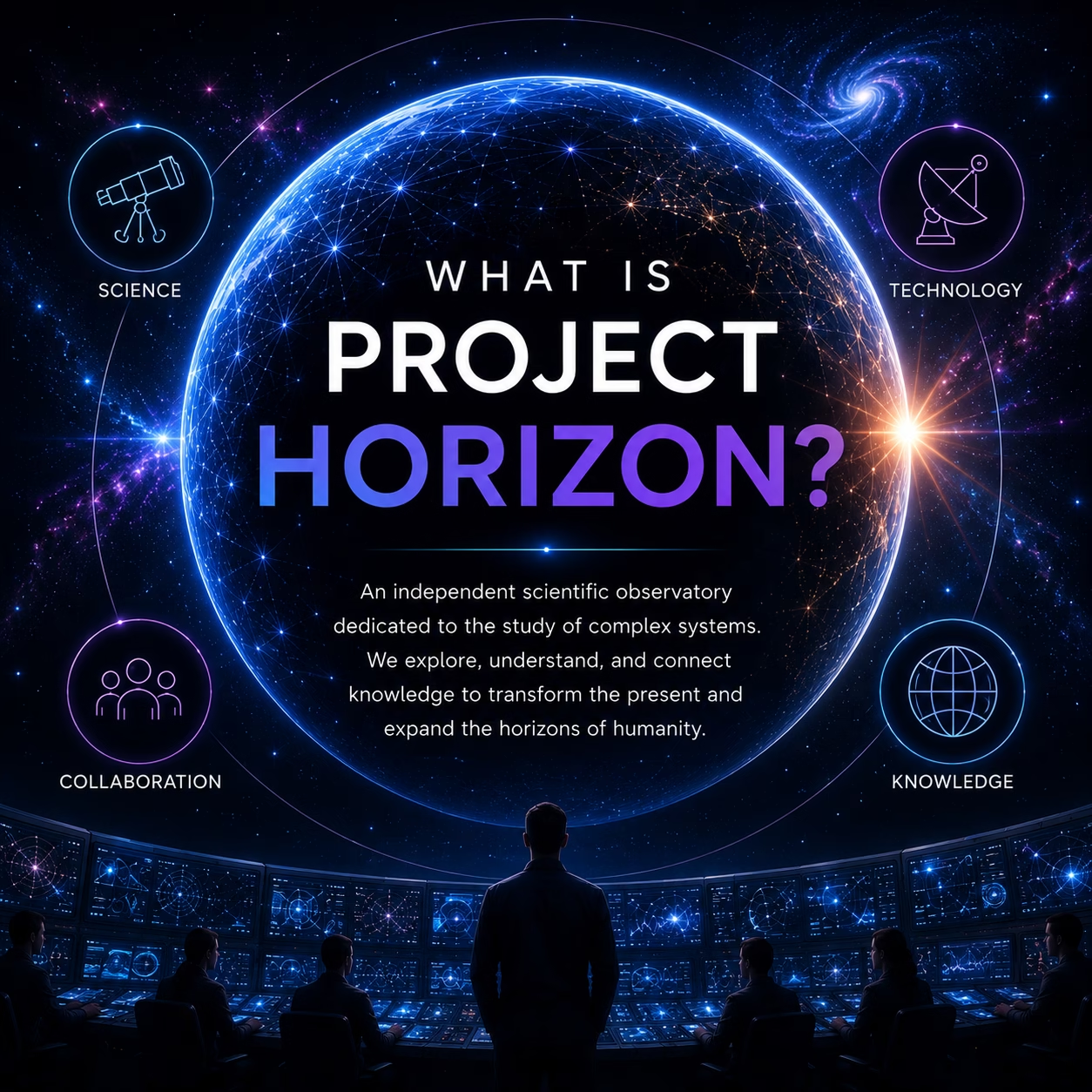
What is Project Horizon?
Project Horizon is an independent scientific research initiative dedicated to understanding how complex systems organize, evolve, and transform over time.
Our work combines theoretical research, computational modeling, observational science, and the development of original analytical frameworks to study emergence, persistent coherence, and adaptive organization across natural, social, economic, and technological systems.
Rather than focusing on isolated events, Project Horizon seeks to uncover the universal principles that govern organizational change in complex environments.
Our Mission
To advance the scientific understanding of complex systems by developing original theories, observational methodologies, computational models, and open research tools that contribute to the study of organization, emergence, and adaptive transformation.
Our objective is to generate knowledge that is rigorous, reproducible, and openly accessible to researchers worldwide.
Our Vision
To become an internationally recognized independent research initiative that contributes new scientific perspectives on complex adaptive systems and fosters open collaboration across disciplines.
We envision a future in which the principles of organization and emergence help advance science, technology, decision-making, and our understanding of complex phenomena.
Research Programs
Project Horizon is organized around four complementary scientific research programs. Each program explores a different dimension of complex adaptive systems while contributing to a unified framework for understanding organization, coherence, and transformation.
CORE
Complex Organizational Regime Engine
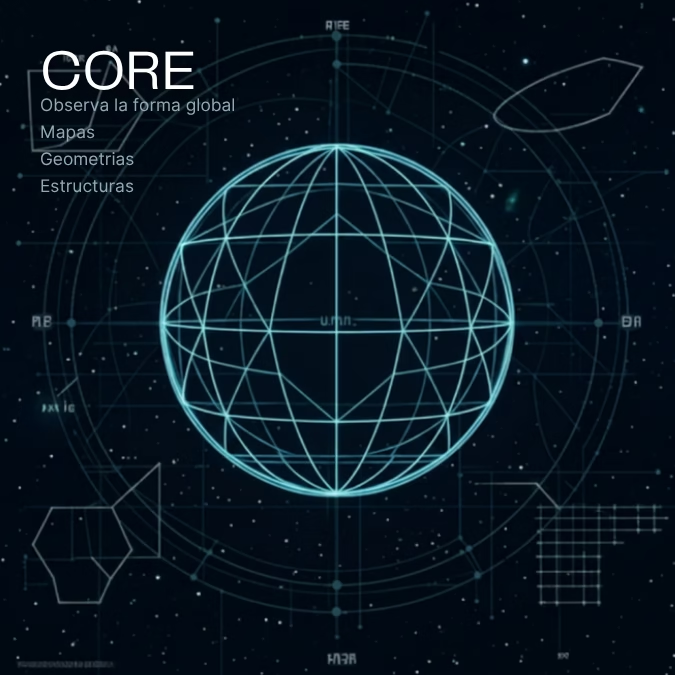
Studies the large-scale structural organization of complex systems, identifying persistent organizational regimes, long-term dynamics, and evolutionary transitions.
QPLAB
Quantitative Physiological Laboratory
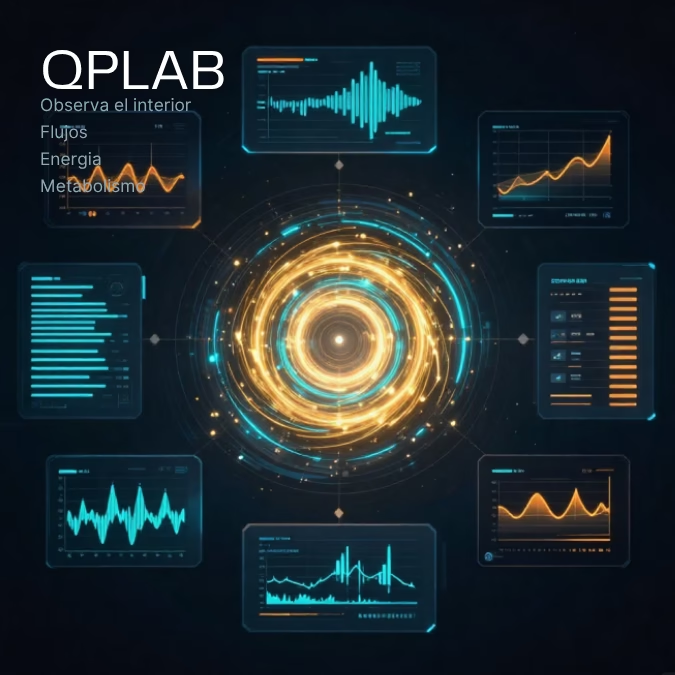
Investigates the internal dynamics of complex systems through physiological-inspired observational variables that describe adaptation, stability, and structural balance.
TPC
Theory of Persistent Coherence
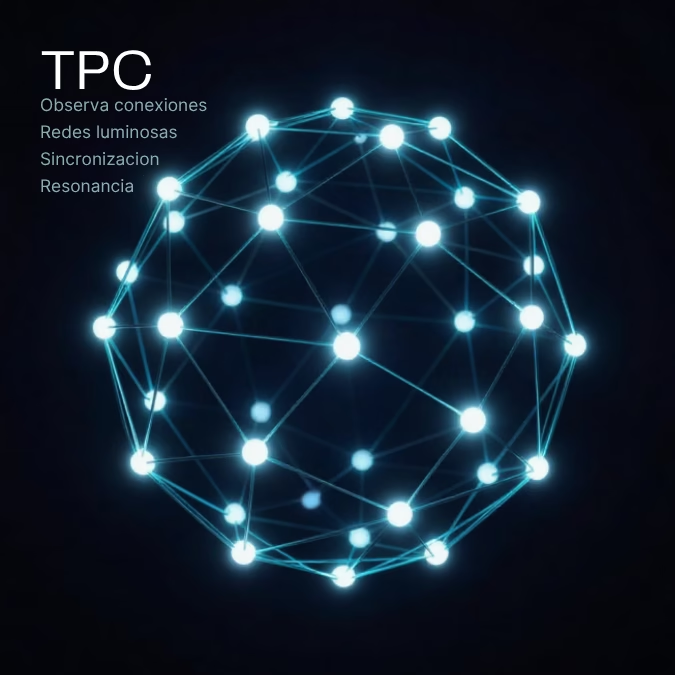
Develops a theoretical framework to explain how complex systems preserve organizational coherence across multiple scales under conditions of uncertainty and entropy.
TPF
Transformation Physiology Framework
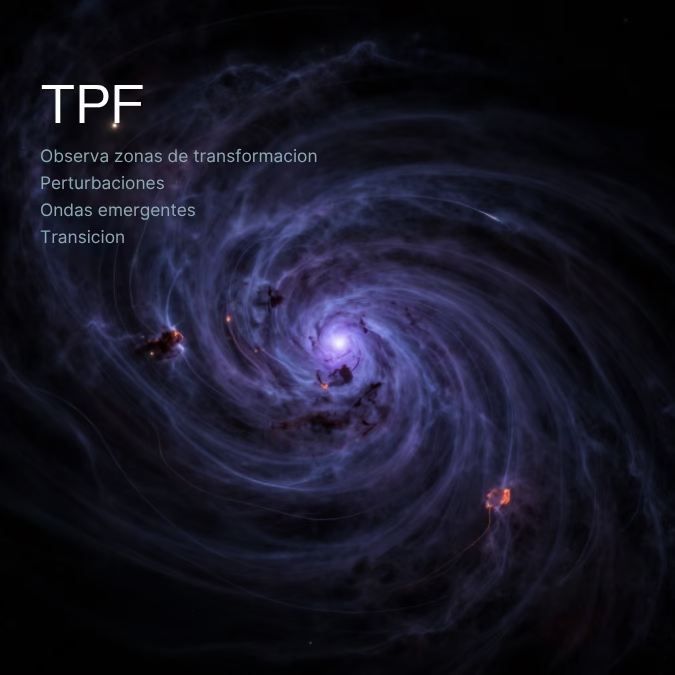
Explores whether transformational processes can be detected before they become externally visible through the observation of internal organizational dynamics.
PROJECT CORE
CORE (Complex Organizational Regime Engine)
ENGINE 1 — CORE
Longitudinal Macrostructural Engine
A research engine dedicated to the study of:
- Structural regimes
- Attractor dynamics
- Structural memory
- Organizational curvature
- Transition energy
- Macrostructural evolution
Core Concept
CORE seeks to answer a fundamental question:
How does a complex organism evolve over the long term?
PROJECT QPLAB
QPLAB (Quantitative Physiological Laboratory)
ENGINE 2 — QPLAB
Quantitative Physiological Laboratory
A microphysiological research laboratory focused on analyzing:
The organism's internal state
Metabolic activity
Internal pressure
Saturation dynamics
Structural fatigue
Dynamic balance
Core Concept
QPLAB seeks to answer a fundamental question:
What is happening inside the organism at this very moment?
PROJECT TPC
TPC (Theory of Persistent Coherence)
ENGINE 3 — TPC
Theory of Persistent Coherence
A scientific framework developed to investigate:
Organizational coherence
Structural persistence
Entropy
Multiscale reorganization
Emergent processes
Central Hypothesis
Complex systems do not survive because they are stable, but because they are capable of preserving coherence under perturbation.
PROJECT TPF
TPF (Transformation Physiology Framework)
ENGINE 4 — TPF
Transformation Physiology Framework
An experimental predictive framework designed to explore alternative approaches to anticipation and transformation detection.
Unlike conventional market models, TPF does not rely on traditional technical indicators.
It investigates:
- Intentional footprints
- Emergent organization
- Physiological time
- Structural metabolism
- Internal dynamics
Fundamental Question
Can a transformation be anticipated before it becomes visible?
Project Status
Scientific Development Stage
🔵 CORE
Hypothesis ─ Theory ─ Instrument ─ Experiment ─ 🔵 Validation ─ Publication Instrument & Experimental Development
🟢 QPLAB
Hypothesis ─ Theory ─ Instrument ─ 🟢 Experiment ─ Validation ─ Publication Advanced Experimental Research
🟣 TPC
Hypothesis ─ Theory ─ Instrument ─ Experiment ─ 🟣 Validation ─ Publication Scientific Validation
🟠 TPF
🟠 Hypothesis ─ Theory ─ Instrument ─ Experiment ─ Validation ─ Publication Theoretical Framework Development
All research programs are developed incrementally through theoretical formulation, computational modeling, experimental validation, and continuous refinement.
Why It Matters
Complex systems are everywhere—from biological organisms and ecosystems to financial markets, social networks, artificial intelligence, and technological infrastructures. Despite their diversity, these systems often exhibit common organizational principles that remain poorly understood.
Project Horizon seeks to uncover those principles by developing new observational methods, theoretical models, and computational tools capable of describing how complex systems organize, adapt, and transform before change becomes externally visible.
Our long-term objective is to contribute to a deeper scientific understanding of complexity and to provide knowledge that can be applied across multiple disciplines.
Featured Research
Theory of Persistent Coherence (TPC)
A theoretical framework proposing multiscale coherence as a fundamental organizational property of complex adaptive systems.
→ Read More
CORE: Structural Organization in Complex Systems
Research on persistent organizational regimes, structural memory, and long-term system evolution through longitudinal observation.
→ Read More
QPLAB: Exploring the Physiology of Complex Systems
Development of novel observational variables inspired by physiological processes to investigate internal organizational dynamics.
→ Read More
Support Project Horizon
Project Horizon is an independent scientific research initiative developed without institutional funding.
If you believe in the value of open and independent research in complex systems, we invite you to support the continuation of this work.
[ Learn how to support the project ]