An investigation · Rufo y Rufo
HiddenPurpose
An investigation into who we are, why we act, and how we find meaning.
First, to know. Then, to believe. Finally, to act.
Or so we thought.
Available on Amazon
Also in Spanish: Propósito Oculto
The question
Is there something behind all of this?
Almost all of us have asked ourselves this question at some point, usually at night, usually without looking for it. This book was born from it.
It does not promise to answer it. It promises to show you how a question changes when you actually take the trouble to investigate it, instead of settling for the first hunch that comes to mind at three in the morning.
Read the full PrologueThe book
Read it like a story. Investigate it like a problem.
A woman gets the time right with a stopped watch. A bacterium with no brain seems to remember the future. Three judges issue a ruling that none of them would sign. A flock of starlings draws in the sky a shape that no bird knows. Everyday stories that, seen up close, take apart the words we thought we understood: knowing, believing, having a purpose, acting.
It is written as a narrative, without jargon and with rigor. It draws on philosophy, psychology, neuroscience, and systems theory, and its appendix shows what comes from the scientific literature, what was built here, and what remains open.
It promises neither a final answer nor a five-step method. It offers something more modest: a far more precise question than the one we started with, and the honesty to say how far what we know goes.
- Genre
- Popular philosophy and science
- Structure
- Prologue, 18 chapters in 7 parts, Epilogue, and Appendix
- Languages
- English and Spanish (Propósito Oculto)
Four stories to begin with

Chapter 1
The Stopped Watch
Marta gets the time right. Did she know it, or just get it right?
Chapter 7
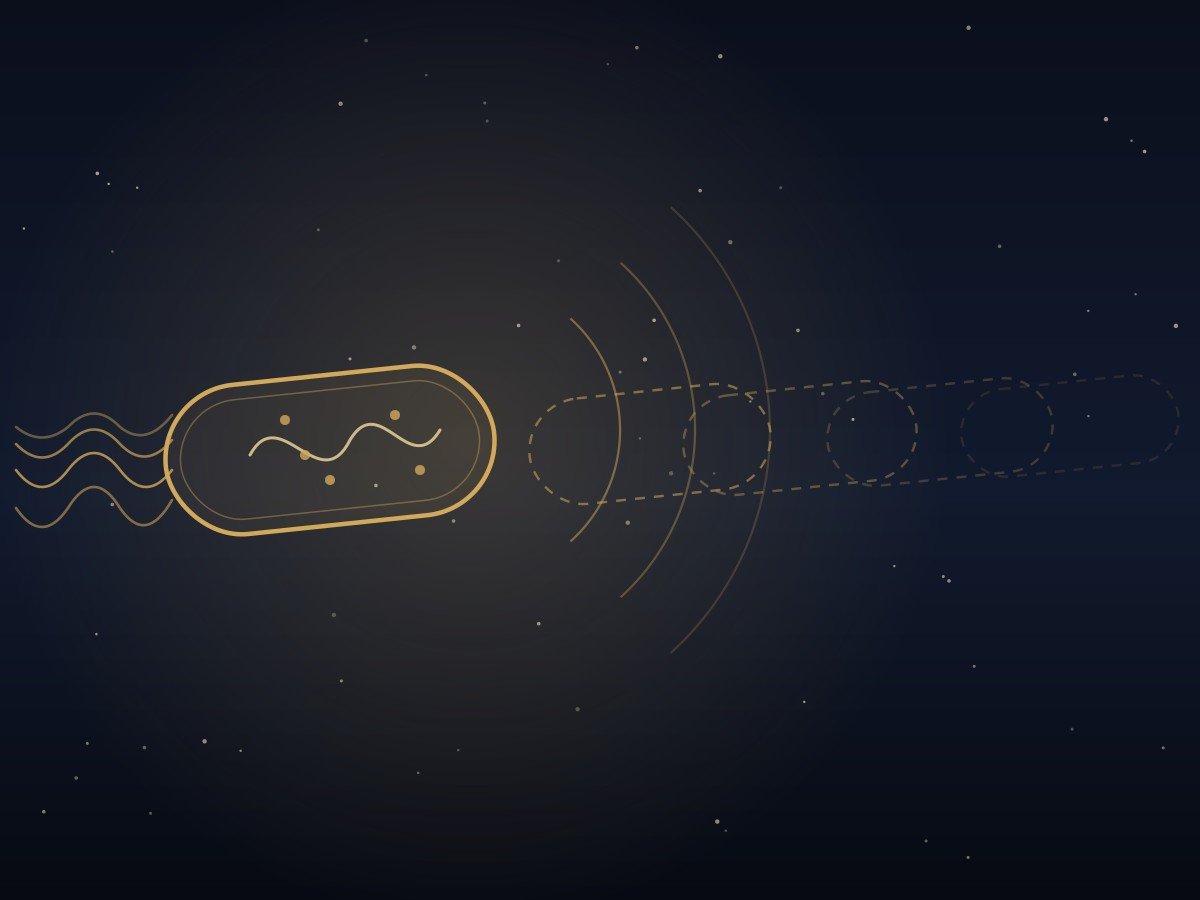
The Bacterium That Seems to Remember the Future
With not a single nerve, it prepares for something that has not yet happened.
Chapter 8
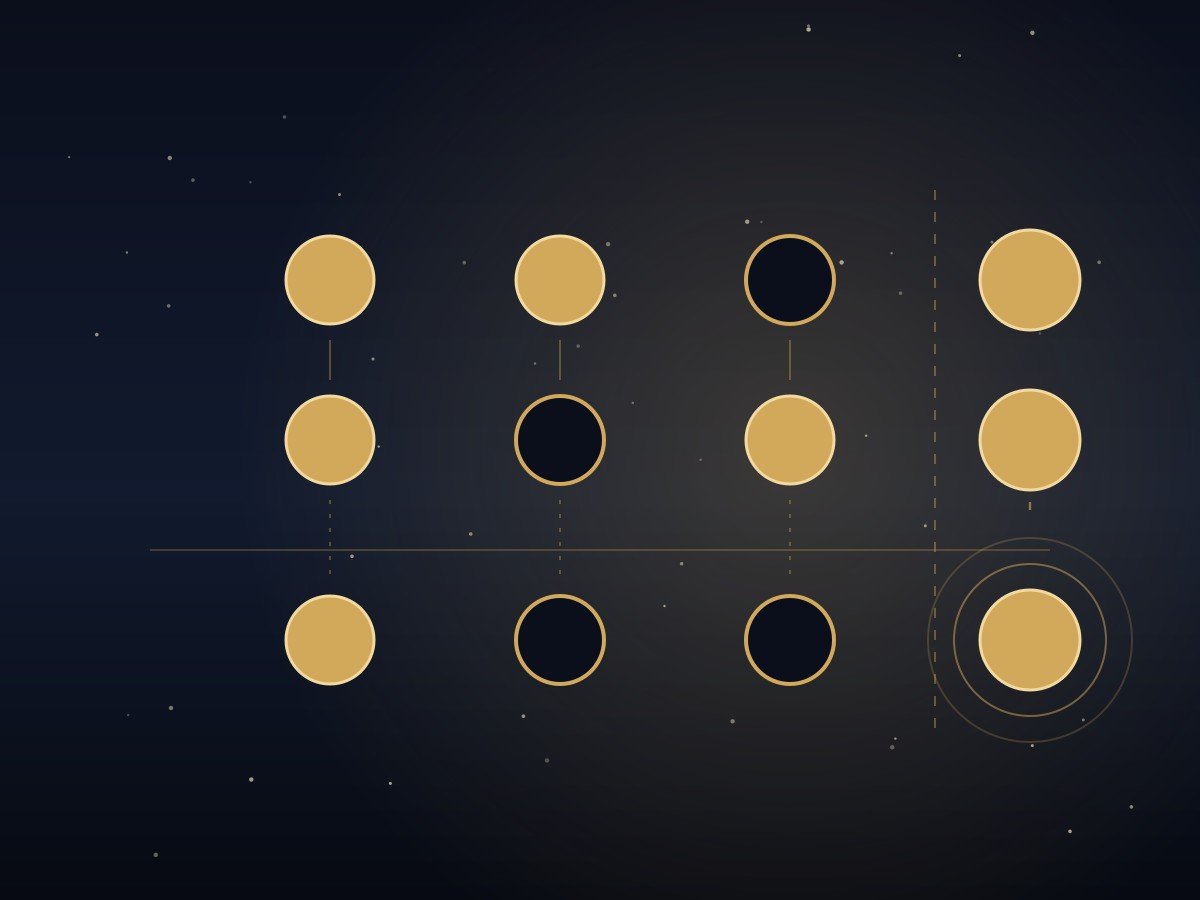
The Court of Three Judges
A ruling that none of the three would sign on their own.
Chapter 16
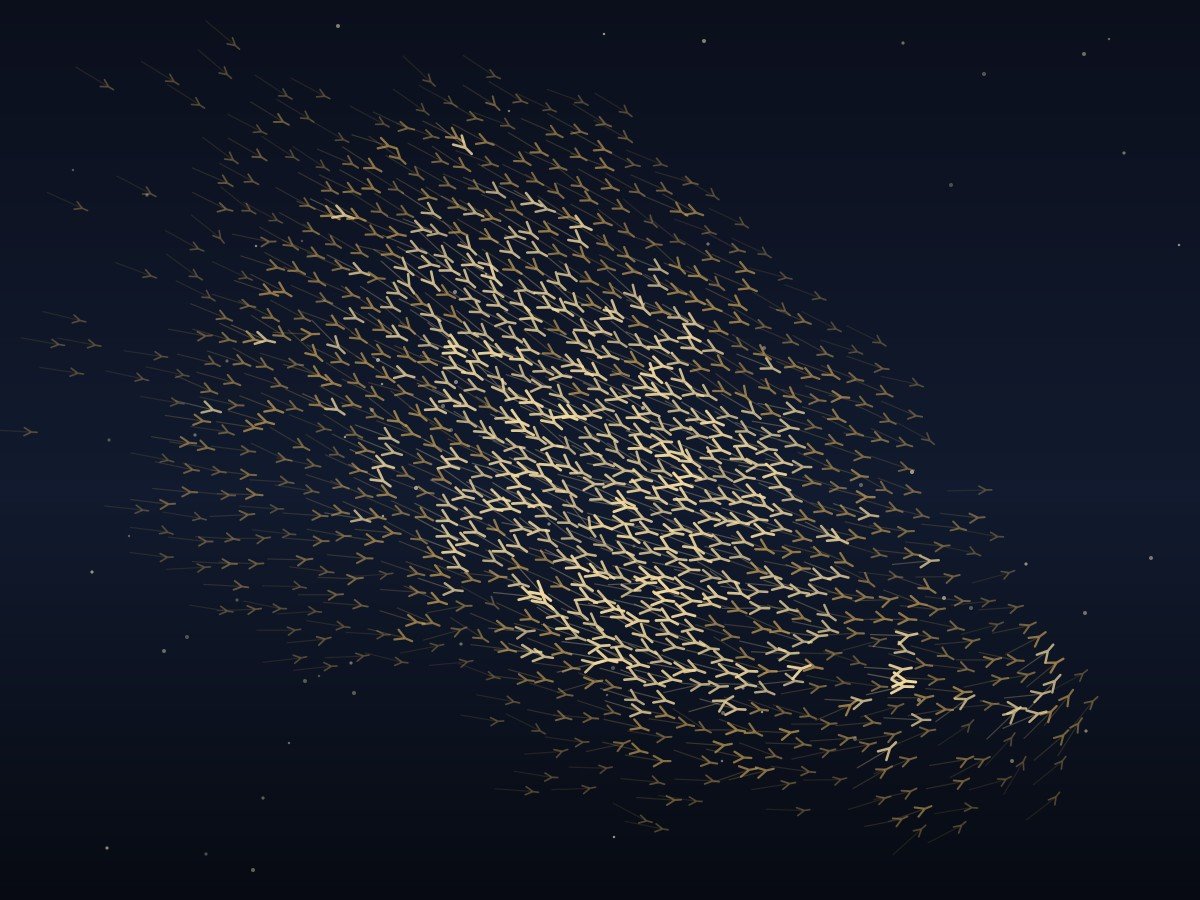
The Flock of Starlings
A shape in the sky that no bird knows.
The seven parts
 Part IThe Four DoorsChapters 1–4 · Knowing, Believing, Having a Purpose, Acting
 Part IIWhen the Four Doors BreakChapters 5–6
 Part IIILooking for the PatternChapters 7–9
 Part IVThree Ways of Looking at the Same ThingChapters 10–12
 Part VThe MapChapters 13–14
 Part VIWhat We Could Not FindChapters 15–16
 Part VIIThe Center That Did Not OpenChapters 17–18
And at the end, an Epilogue—what we found while looking for something else—and an Appendix: how we researched what we tell.
The map
Four words, four pieces
When we opened up the four words we began with, we found the same pieces spread in different proportions. Choose a word and see which pieces it needs, according to Chapter 6.
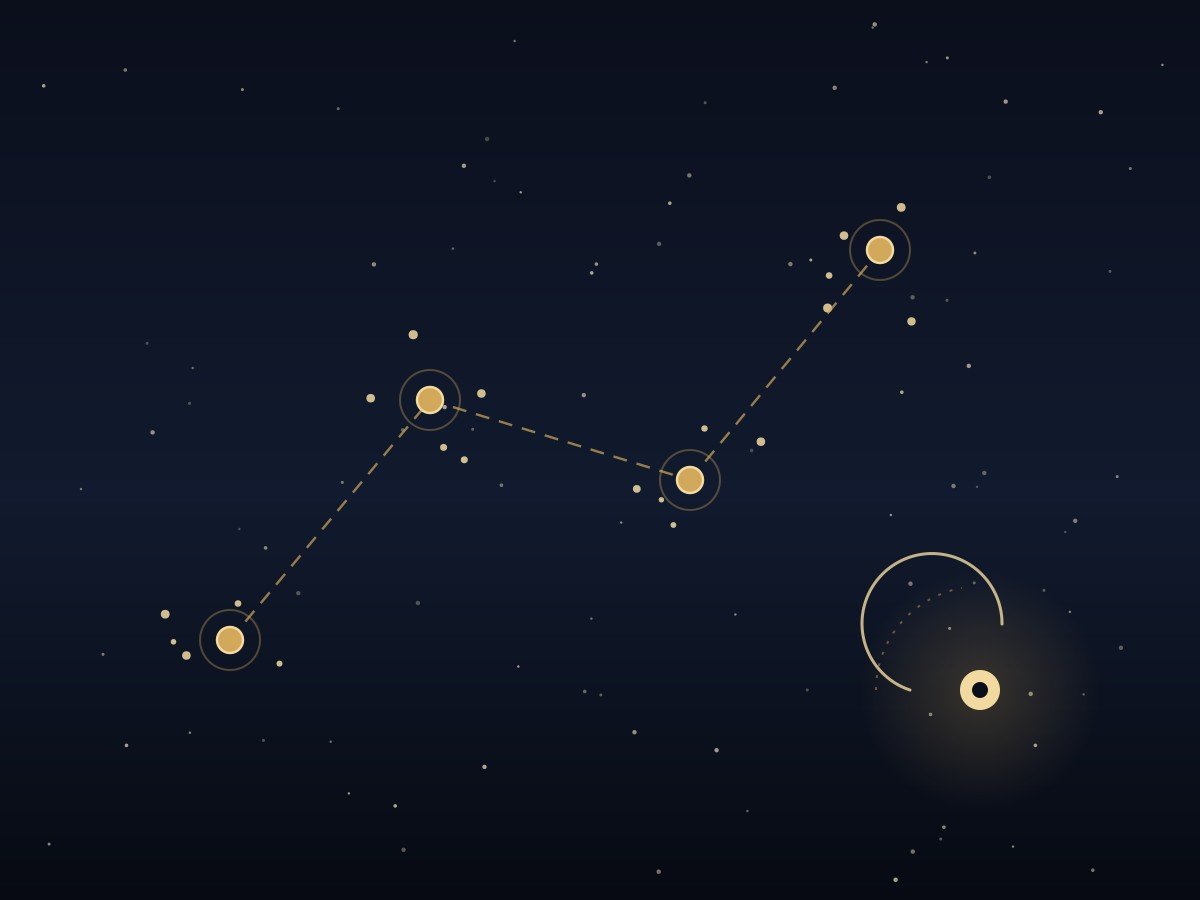
The stars were real. The lines that joined them were not.
Knowing needs, above all, that it not be a stroke of luck and that it can be corrected. That it matter to you barely takes part: you can know something that is completely indifferent to you.
An illustrative sketch of what the chapter says, not measured data. Where the book is silent, the bar stays empty.
Chapter 18
Three uncertainties worth keeping apart
1
Not knowing enough
The forecast says seventy percent chance of rain. The atmosphere hasn’t decided anything: it is we who don’t have all the data.
2
Not being fixed in advance
A radioactive atom disintegrates at an instant that, according to the best physical theory, no prior state determines. It is not that the universe knows it and we don’t.
3
Openness that is someone’s
The most demanding: that the resolution of an open possibility genuinely belong to the system that resolves it, neither by prior calculation nor by a chance that is no one’s. In eighteen chapters we did not find it demonstrated. Nor did we find it ruled out.
A thought experiment
In the argument from Chapter 17 you are about to say the words that hurt most. Imagine that what decides between your keeping quiet or not were a coin.
Press to toss it.
Would you now say “I decided to keep quiet”? Pure chance, however genuine, does not give you back authorship: it only changes who—or what—is not you.
How we researched it
How we researched what we tell
This site does not ask you to believe us because we did a lot of research. It shows you which part comes from others, which part we built ourselves, and where the evidence ends. As in the book, we do not present as facts what are still hypotheses.
Five states for every claim
- Known
- There is sufficient evidence.
- Probable
- There is favorable evidence, but it is not conclusive.
- Hypothesis
- It must be investigated.
- Faith
- A conviction that does not depend exclusively on demonstrable evidence.
- Unknown
- We do not have sufficient knowledge.
Traceability, chapter by chapter
Three clarifications
Starlings (Chapter 16)
Reynolds (1987) is a computational model; Ballerini and colleagues (2008) measured real flocks. The chapter narrates them together, but they are different things: a model and a measurement.
Libet and Schurger (Chapter 17)
They are not to be read as a block demonstrating that agency does not exist. The later work of Schurger and colleagues questions and weakens the classic reading of Libet.
Our own categories
The difference between something emerging and something being genuinely open is not an established concept under those names. It is an organizing tool of ours, not a finding you can cite as “demonstrated by science.”
Essential bibliography
Only the sources that directly support the content of the chapters.
- Ballerini, M. et al. “Interaction Ruling Animal Collective Behavior Depends on Topological Rather Than Metric Distance.” PNAS 105(4), 2008.
- Barandiaran, X., Di Paolo, E., and Rohde, M. “Defining Agency: Individuality, Normativity, Asymmetry, and Spatiotemporality in Action.” Adaptive Behavior 17(5), 2009.
- Bruineberg, J. “Active Inference and the Primacy of the ‘I Can’.” In T. Metzinger and W. Wiese (eds.), Philosophy and Predictive Processing. Frankfurt am Main: MIND Group, 2017.
- Buchak, L. “Can It Be Rational to Have Faith?” In Probability in the Philosophy of Religion, 2012.
- Cohen, L.J. An Essay on Belief and Acceptance. Oxford University Press, 1992.
- Conant, R., and Ashby, W.R. “Every Good Regulator of a System Must Be a Model of That System.” International Journal of Systems Science 1(2), 1970.
- Davidson, D. “Actions, Reasons, and Causes.” Journal of Philosophy 60(23), 1963.
- Di Nucci, E. “Automatic Actions: Challenging Causalism.” Rationality Markets and Morals, 2011.
- Di Paolo, E. “Autopoiesis, Adaptivity, Teleology, Agency.” Phenomenology and the Cognitive Sciences 4(4), 2005.
- Frankfurt, H. “The Problem of Action.” American Philosophical Quarterly 15(2), 1978.
- Friston, K. “The Free-Energy Principle: A Unified Brain Theory?” Nature Reviews Neuroscience 11(2), 2010.
- Friston, K., Thornton, C., and Clark, A. “Free-Energy Minimization and the Dark-Room Problem.” Frontiers in Psychology 3:130, 2012.
- Gettier, E. “Is Justified True Belief Knowledge?” Analysis 23(6), 1963.
- Howard-Snyder, D. “Propositional Faith: What It Is and What It Is Not.” American Philosophical Quarterly 50(4), 2013.
- Jabbur, M.L., Bratton, B.P., and Johnson, C.H. “Bacteria Can Anticipate the Seasons: Photoperiodism in Cyanobacteria.” Science 385(6712), 2024.
- Kornhauser, L., and Sager, L. “Unpacking the Court.” Yale Law Journal 96(1), 1986.
- List, C. “Can AI Systems Have Free Will?” Synthese 206(3), 2025.
- List, C., and Pettit, P. “Aggregating Sets of Judgments: An Impossibility Result.” Economics and Philosophy 18(1), 2002.
- Mitchell, A. et al. “Adaptive Prediction of Environmental Changes by Microorganisms.” Nature 460(7252), 2009.
- Montévil, M., and Mossio, M. “Biological Organisation as Closure of Constraints.” Journal of Theoretical Biology 372, 2015.
- Nisbett, R., and Wilson, T. “Telling More Than We Can Know.” Psychological Review 84(3), 1977.
- Parr, T., Pezzulo, G., and Friston, K. Active Inference: The Free Energy Principle in Mind, Brain, and Behavior. MIT Press, 2022.
- Popper, K. The Logic of Scientific Discovery. 1959.
- Powers, W.T. Behavior: The Control of Perception. Aldine, 1973.
- Reynolds, C. “Flocks, Herds, and Schools: A Distributed Behavioral Model.” Computer Graphics 21(4), 1987.
- Rietveld, E., and Kiverstein, J. “A Rich Landscape of Affordances.” Ecological Psychology 26(4), 2014.
- Schurger, A., Sitt, J.D., and Dehaene, S. “An Accumulator Model for Spontaneous Neural Activity Prior to Self-Initiated Movement.” PNAS 109(42), 2012.
- Sjöberg, R.L. “The Readiness Potential and the Soul: What Happens When You Resect Their Seat in the Brain?” Brain 147(7), 2024, 2267–2269.
- Steward, H. A Metaphysics for Freedom. Oxford University Press, 2012.
- Tagkopoulos, I., Liu, Y.C., and Tavazoie, S. “Predictive Behavior Within Microbial Genetic Networks.” Science 320(5881), 2008.
Prologue
The Question
There is a question almost all of us have asked ourselves at some point, usually at night, usually without looking for it.
Sometimes it arrives after an ordinary day, when you’ve already turned off the light and the ceiling just stays there, waiting. Sometimes it arrives after something extraordinary: a loss, a piece of news, a hug that lasted longer than usual. And sometimes it arrives for no reason at all, simply because the human brain, left alone for a moment, tends to ask questions that are not exactly helpful for falling asleep.
What am I doing all this for?
Behind that small question there is usually a bigger one, one we rarely say out loud because it sounds far too solemn for breakfast:
Is there something behind all of this?
This book was born from that question. But it is not a book that promises to answer it. We say so here, on the first page, so as not to deceive anyone: if you are looking for the final answer, close it now and save yourself some time. What we can promise is something different, and we think better: we are going to show you how a question changes when you actually take the trouble to investigate it, instead of settling for the first hunch that comes to mind at three in the morning.
We started, like almost everyone, with a fairly reasonable intuition. It seemed to us that a person’s life—anyone’s life, anywhere—could be described more or less like this:
First you come to know something.
Then you believe in something.
That gives you a purpose.
And that purpose leads you to act.
Knowledge, faith, purpose, action. Four words we use every day without thinking twice. “I know what I want.” “I haven’t lost faith.” “I need to find meaning in this.” “Something has to be done.” Four steps, one after the other, like a staircase anyone could climb.
It struck us as an idea so simple and so obvious that we decided to investigate it seriously. We were going to show, carefully and rigorously, that this was indeed how it worked: that knowledge leads to faith, that faith produces purpose, that purpose drives action.
That is not what we found.
The first thing that happened was more uncomfortable than we expected: each of those four steps, looked at up close, turned out not to be a solid step at all, but a box full of smaller pieces. “Knowing” was not one thing. Neither was “believing.” Nor “having a purpose,” nor “acting.” Every word we had taken for granted opened up, like those Russian dolls that never end, into ever finer questions.
And then something even stranger happened. When we began to compare the pieces we had found inside each box, we noticed that some of them looked suspiciously like pieces from other boxes. A property that showed up when we investigated what it means to “know” showed up again, almost identical, when we investigated what it means to “have a purpose.” It was as if the four boxes, instead of being four different things stored separately, were really compartments of the same piece of furniture, and the pieces had been slipping from one to another over time.
That was when the question changed. It was no longer “does knowledge lead to faith?” It was another one, more unsettling and, for us, far more interesting:
What if knowledge, faith, purpose, and action were not four different things, but different ways of naming something deeper that we still don’t know what to call?
This book tells that journey. It is not a novel, although at times it reads like one: there are discoveries, there are dead ends, there is a moment when a court of three judges produces a ruling that none of the three would have signed on their own, and there is a bacterium that seems to guess the future without having anything resembling a brain. Nor is it a self-help book: it won’t tell you how to find your purpose in five steps, because by the time you finish reading it you will understand why that promise, made with such simplicity, probably cannot be honestly kept.
It is, if anything, the record of a real investigation: that of two people—we, Rufo y Rufo—who began with a comfortable question and ended with a more precise one, a stranger one and, we believe, a far more honest one.
We are not going to give away the ending. But we can tell you, right now, something we only understood once we had finished: the question we started with was not exactly wrong. It was just too simple for what we were really looking for.
Come along. We’re going to show you where it took us.
First, to know.
Then, to believe.
Finally, to act.
Or so we thought.
Authors
Rufo y Rufo
Two voices, one question. They began with a comfortable question and ended with a more precise one, a stranger one and, they believe, a far more honest one.
Buy on Amazon